

The following article is the transcript of my latest YouTube video, lightly edited for reading. Prefer to watch? Click the video above.
It’s completely illogical. You’ve done 99% of the work. You’ve mastered your strategy, applied the right size, and taken the correct setup.
You’ve sat with uncertainty and the internal pressure rising as the trade plays out in front of you, and then you just… exit.
Your profit target wasn’t hit, but neither was your stop loss. There was no clear indication from your strategy that it was time to exit the trade. You let your emotions drive your actions instead of following the plan. You sabotaged yourself at the exact moment that you stood to reap the rewards of your hard work.
And the worst thing is, this is a pattern that you keep repeating. You might even be asking yourself, am I just too anxious to stay in the trade, or do I have some hidden block around allowing myself to make money in the market?
The frustration is valid because the evidence is clear. If you could overcome this one execution issue, you could significantly increase your profitability.
In this article, I’m going to decode the psychology behind exiting both winning and losing trades early, and I’m going to give you a simple approach to follow to fix it.
Why am I in a position to help? I’m a Chartered Performance Psychologist with the Psychological Society of Ireland, and I’ve been coaching performers in high-stakes arenas since 2007. In my almost 8 years working with traders and hedge fund managers, I’ve seen the same execution issues so often that decoding the patterns behind them is like doing a simple jigsaw puzzle for me.
If you’re ready to put an end to exiting trades early, my full solution is my Go Deep to Level Up Your Trading™ program. But for this article, we’re going to mainly focus on understanding the root drivers of the issue.
Different problems, similar root cause
You might think that exiting a winning trade too soon and exiting a losing trade too soon are different problems, but the psychology driving both violations is similar.
Let’s look at what’s happening at a conscious level when you’re in a trade and you get that impulsive urge to get out early. You’ve done most of the hard work to get into the trade, assuming that you’re following your plan up to that point, but the longer you’re in the trade, the more uncertainty you’re exposed to, and therefore the more pressure you come under.
There is no guarantee as to the outcome of the trade, even if you execute your plan to a T. Your discomfort and anxiety may become more pronounced as the trade continues and the pressure rises. And this can be true whether you’re winning or losing.
Winning versus losing trades
If you’re in a winning trade, your anxiety is likely focused on banking profit as quickly as possible and avoiding the pain of giving back unrealised gains. Better to take a small profit and get out rather than lose the gains and get stopped out at breakeven, or, worse still, take a loss.
Exiting the winning trade early is actually an act of self-soothing. It’s a way of removing the uncertainty of the outcome, avoiding the pain of a loss, feeling in control, and satisfying a mindset that says that money is scarce and it must be held on to as tightly as possible when it presents itself.
On the other hand, if you’re in a losing trade, your anxiety is likely focused on stopping the bleed. Even if your trading plan allows for pullbacks and reversals, the discomfort of sitting in the drawdown may override your logical intention to give the trade room and to allow it to play out on its own terms.
You want to minimise damage to your account, protect yourself from a big loss, and give yourself a fresh start on the new trade. Again, exiting early is an act of self-soothing.
It’s not a matter of discipline
Neither version of the plan violation is logical. Your trading plan has likely been carefully constructed based on logic and backtested to prove its theoretical profitability. If logic were driving your actions, you’d follow your plan.
What’s happening is that your own thoughts and highly charged emotions become too uncomfortable to withstand. And so exiting the trade is how you stop the in-the-moment pain. It’s not an act of indiscipline or lack of willpower. It’s an act of self-protection.
If a trader doesn’t understand this distinction and they’re still running the old “I need to improve my discipline” script, then they’re likely going to give most of their focus to the problematic behaviour — pulling the trigger early on the exit. But this behaviour is simply the outcome of a chain of events that is happening at a deeper level within the trader.
If you’re trying to elicit genuine behaviour change that can be sustained over time and withstand pressure, you can’t do this without understanding and addressing every link in that chain.
Specifically, you have to understand and address the emotions that precede the act of exiting the trade early, the thoughts that precede those emotions, and the deeply held subconscious beliefs that precede those conscious thoughts. And finally, you have to understand how pressure activates that chain of events and leads to you exiting the trade prematurely. This is my proprietary Decode Your Blocks framework that I follow for helping traders decode any execution block that is negatively impacting their trading.
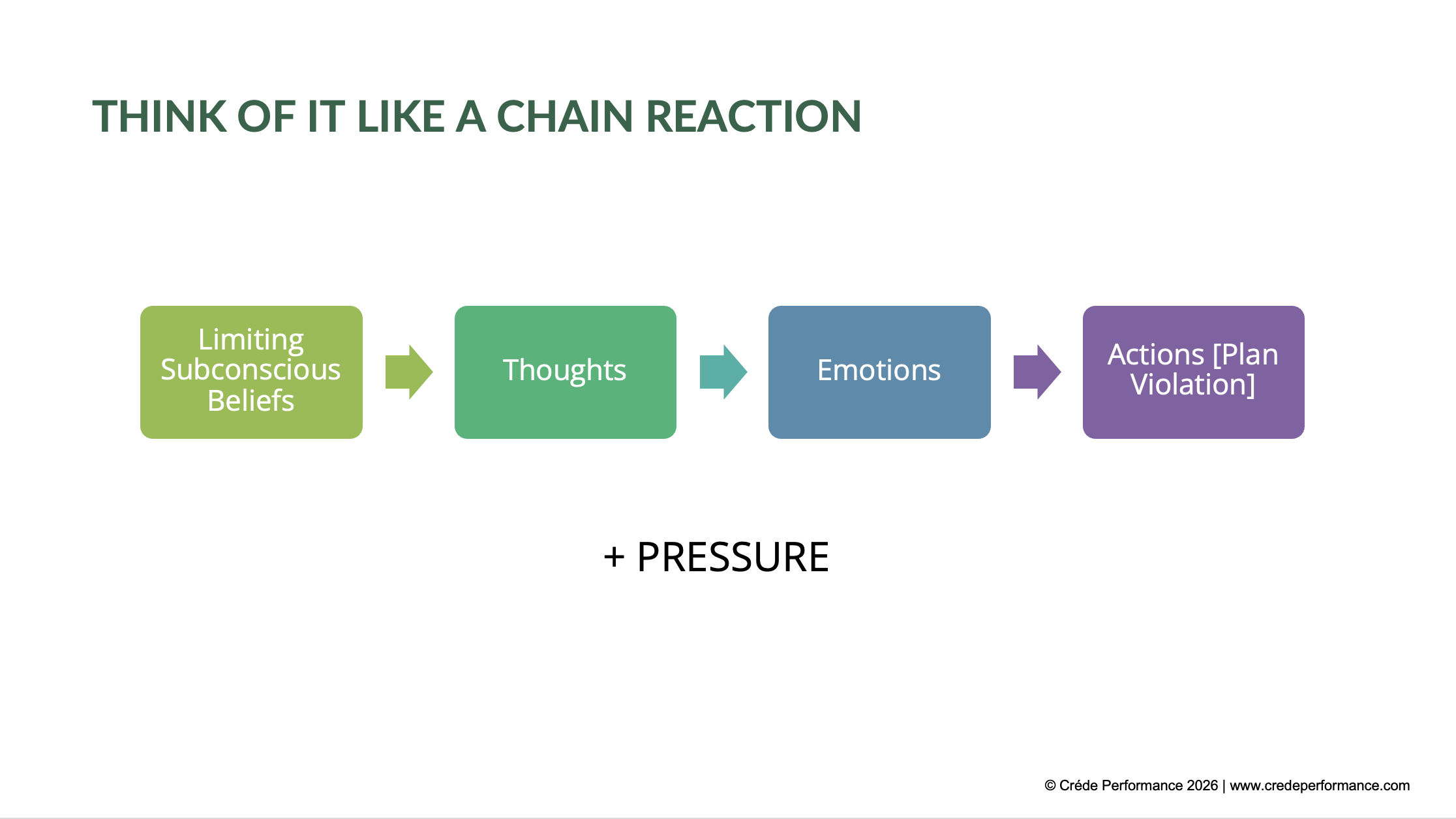
This is why many common fixes for exiting trades early fall short. They don’t take into account or address every link in the chain. They promise deep and lasting transformation but propose surface-level fixes.
Decoding the chain of events
In the context of exiting trades early, we can map the chain of events along each step of the Decode Your Blocks framework:
At the emotional level, the trader is feeling a highly charged emotion, such as fear of losing, discomfort in the face of uncertainty, or panic or dread at the thought of losing money — either real money or unrealised gains.
But these emotions only arise because the trader is making an interpretation about an objectively neutral situation. The trade is playing out within the boundaries of the plan, but the trader is telling themselves a story about these events, and the story shows up in their conscious thoughts:
I have to protect my money because I don’t have enough.
It’s more important to finish the trade green than to extract max profit.
I don’t want the shame of another losing trade.
If I keep on losing trades, I’m never going to make it as a trader.
These are the thoughts that are running through the trader’s mind in the moment, giving rise to the emotions that trigger the self-protective mechanism of exiting the trade early.
But beneath these thoughts lie the trader’s subconscious or core beliefs about themselves and the world. These are the deeply held beliefs and patterns that mostly form in our childhood and get reinforced throughout our lives. It’s these core beliefs that shape the significance that the trader is placing on the events of the trade.
For example, a trader may have been taught in childhood that achievement brings love and approval from their parents, and so they develop the core belief that “I have to achieve in order to deserve love”. If a trader brings this core belief to the market and they’re in a losing trade, then they stand to lose not only their money but also their perceived self-worth if they accept a large loss, even if the trade was perfectly executed according to their plan.
Or if a trader has the core belief of “money is scarce and I never have enough”, and that’s deeply rooted in their parents’ struggles with money when they were a child, they’re going to sit in a winning trade and feel an overwhelming urge to grab any profit that they can and run.
They won’t want to risk losing out on bankable profits for the potential of greater gains because the goal has unconsciously become self-soothing rather than executing according to their plan.
Pressure is the variable that activates this whole chain and amplifies the impact that every link in that chain has on the execution behaviour. You might have unhelpful core beliefs around money and self-worth that remain latent and don’t influence your trading actions as long as the pressure stays low, for example, when you’re trading on sim or you’re passing an evaluation for the 50th time. But when the pressure heightens, the cracks in your psychology start to show, and then that drives you to exit the trade early.
The approach to stop exiting trades too early
We’ve broken down the key factors involved in exiting trades early, and we’ve explained how those factors interact. But the obvious question remains: How do I fix it?
You systematically address each of these factors in isolation using performance psychology techniques. And then you create a mental conditioning routine so that you work on all of these aspects of your psychology each week.
Think of it like a gym program for somebody who wants to improve cardio fitness and muscle tone. They’ll get individual exercises for improving speed, endurance, and specific muscle groups, and then they’ll combine those exercises into a conditioning routine that they practise every week to achieve their goals.
In this context, we’re talking about:
Managing your emotions in the heat of the trade
Challenging the biased and flawed thinking that gives rise to those emotions
Rewiring your core subconscious beliefs around money, self-worth, and achievement
And optimising your resilience to pressure, so that you can stay focused on the execution of your plan instead of self-soothing no matter what level of pressure you’re under in the trade.
This systematic approach to overcoming execution challenges is the foundation on which my Go Deep to Level Up Your Trading™ program is built. The program gives you the techniques to address every individual link in the chain: your emotions, your thinking, your subconscious beliefs, and your response to pressure. Then it guides you through combining these into a personalised mental conditioning routine that you practise weekly and integrate into your trading, just like a personally tailored gym program for your mind.
Join me for a live Q&A: bring your trading psychology questions

If you’re struggling with exiting trades early, or any other trading psychology challenge, join me for a Substack Live Q&A on Tuesday 17th November at 4:15pm ET/ 1:15pm PT). I’ll be answering your questions live to help you to break through the mental and emotional blocks impacting your trading execution. Here’s the link to join 👉 Join the Live
You can send me your question in advance through this 30-second form 👉 Click Here to Access the Form. Or simply leave your questions in the comments. If there’s time, I’ll also take questions from the chat during the Live. Hope to see you there!
If this post resonated, subscribe to Backing Yourself for more insights on the psychology of succeeding in high-stakes arenas where the safety net is you.